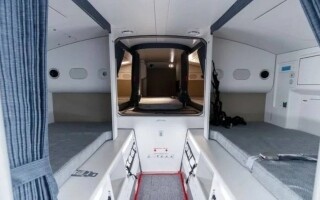
On long-haul flights lasting ten hours or more, there are special rules for crew rest. Typically, such flights have three pilots: one rests for a few hours, while the other two remain on duty. For example, on an 11-hour flight, two hours are spent on takeoff and landing, with all three pilots in the cockpit. As a result, long flights always have at least two, and often more, pilots to provide relief during rest periods. Markus Fahle, a spokesman for the German pilots' union (Cockpit), explains that large aircraft are equipped with special crew rest areas, called 'crew rest compartments'. Pilots' sleeping quarters are located either directly behind the cockpit or above the passenger cabins. 'You get there via a small ladder,' Fahle says. While passengers on a long flight try to catch a short nap or get comfortable in tight seats, there is a special, private rest area on the plane, hidden from everyone's view: the pilots' rest compartments. These secret compartments are fully equipped, allowing pilots to recharge and remain ready to safely fly the aircraft. All major airlines adhere to strict regulations that define pilot flight hours and mandatory rest periods to ensure their safety and the safety of passengers. After takeoff and landing, nine hours remain, allowing each pilot to sleep for three hours. 'Deep sleep is impossible,' Fahle says, based on his experience as a pilot. Wide-body aircraft have hidden crew rest compartments, whose location varies depending on the aircraft model. In this low-ceilinged space, there are two sleeping bunks where it is impossible to stand upright. Airlines organize sleep schedules independently. In modern aircraft, these compartments are usually located above the main cabin, while in older aircraft, they may be in the cargo hold or a special crew section. Despite their small size, these rest areas are much more comfortable than passenger seats. They are equipped with soundproofed bunks, adjustable lighting and temperature, a space to change clothes, and a bed size of at least 78 by 30 inches. Despite their modest dimensions, these compartments include all safety equipment, including oxygen masks, seatbelt light indicators, and internal communication systems to connect with the cockpit and the rest of the crew. This focus on pilot rest is a lesson learned from the painful history of aviation. Fatigue has been linked to many accidents, such as the 1999 crash of an American Airlines flight that killed 11 people. Some modern aircraft, like the Airbus A380, offer larger crew areas with beds equipped with curtains for privacy, allowing pilots to get enough rest during the flight, according to the Slashgear website. These spaces are not a luxury but a necessity to ensure the safety of millions of passengers on long-haul flights, making pilot sleep a critical element of every flight's success.