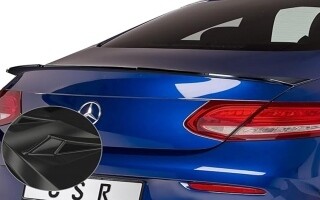
Some car models require spoilers to be installed in specific positions. The term 'spoiler' is often used interchangeably with 'rear wing', although each has different characteristics and functions. A spoiler interacts with the airflow from one side, while a rear wing interacts from both the top and bottom. Therefore, a rear wing is mounted on a support, whereas a spoiler is attached directly to the car's body. Furthermore, a wing operates with greater precision and is designed to direct airflow more purposefully. Its primary aim is to guide air around the vehicle to reduce drag. There are also sill spoilers to prevent dirt from the wheels from reaching the doors, in addition to their role in enhancing the car's aerodynamics. Accessory stores and tuning companies offer both standard and aftermarket spoiler units for nearly all car classes, including sports cars, vans, and SUVs. Typically, units installed by accessory shops serve only to give the car a more sporty appearance and often fail to meet other requirements that necessitate specific design features tailored to each model. Most rear spoilers are attached to the vehicle with a special double-sided tape or adhesive materials. This raises the question: do these spoilers offer practical benefits, or are they merely for aesthetic appeal? The German automotive magazine 'Auto Zeitung' states that a car's spoiler, whether front or rear, is more than just an attractive sporty touch; it offers numerous advantages in both design and performance, especially for sports cars and hypercars. Experts from the magazine explain that a spoiler improves the car's aerodynamic properties and handling, increasing stability, particularly at high speeds and when taking corners. They note that most spoiler units are made from lightweight, high-quality materials such as ABS plastic (Acrylonitrile Butadiene Styrene) or carbon fiber. Some companies also produce units from polypropylene plastic or polyurethane (PU). Types of spoilers available on the market include the rear spoiler, which is mounted on the trunk lid of coupes and sedans; a roof spoiler for vans, SUVs, and station wagons; and a front spoiler, also called a 'lip', which ensures better airflow distribution in front of the car to achieve higher aerodynamic performance or to increase airflow into the engine compartment for cooling. Other types of spoilers are found on the sides of the car, on the corners of bumpers, or on the sills and fenders.