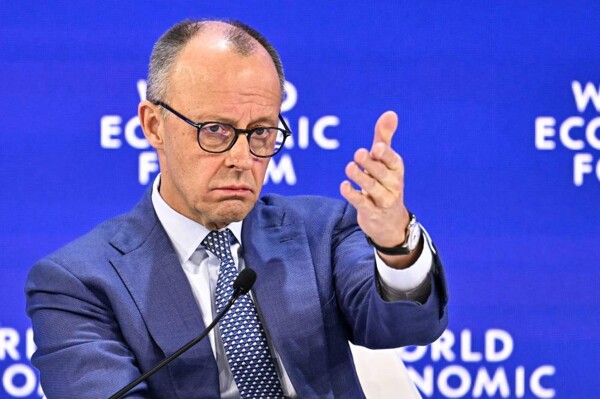
German advisor Friedrich Merz spoke of Europe's need to strengthen its economy, yet they have consistently failed to link these ambitious visions with practical steps to achieve growth. The hesitation in activating the transatlantic cooperation initiative was not so much due to the coordination of economic and political tools, but rather stemmed from an unwillingness to use the European Union's influence at the expense of limited national maneuvering room. Political leaders were more eager to retain the power to prevent bank mergers and engage with Trump, rather than work on building a Europe with an influential economic and political role in the world of tomorrow, despite growing public support for the European Union. The second related issue is that divisions within Europe on how to deal with the United States go beyond tactical matters related to the use of the carrot-and-stick methods employed by the European Union. It is unclear how long Meloni will continue her dual role between Brussels and Washington, while Hungarian Prime Minister Viktor Orbán has long ceased working with his counterparts in the European Union and has now agreed to join the 'Peace Council' in Gaza, announced by Trump. This European clamor is being viewed as a sign of internal and external weakness, and some of these disagreements may never end. European leaders preferred flattery and appeasement over a firm stance, thereby losing credibility with the United States, while the markets treated the prospect of a European Union response with all seriousness. The Greenland experience shows that this clamor can be turned into 'strategic ambiguity' by keeping hostile forces in the dark about the full extent of the European Union's response, and by purposefully using Brussels's sophisticated and multi-faceted tools. From 'The Guardian'.
Divisions within Europe on how to deal with the United States go beyond tactical matters related to the use of the carrot-and-stick methods employed by the European Union. In parts of Eastern Europe, the United States is a fundamental element of the 'post-Soviet identity'. Most likely, his speech was brilliant, allowing him to achieve the desired result regarding Greenland. Previous talks between Americans and Danes to address the reasons for the United States' desire to annex Greenland did not yield the expected results, whether related to national security or the natural resources hidden beneath the island and the speed of launching from it into space. It appears that additional guarantees from NATO and Europe on these matters are part of the 'framework' discussed by Rutte and Trump to end the crisis, such as banning China from mining and offering Greenland as a base for the American 'Golden Dome' project. But what truly changed the calculations was the threat of retaliatory measures worth $93 billion, which alarmed the markets and pushed Trump to back down, as Europe could also use its economic influence to its advantage. Ironically, the Europeans were not far from uniting their capabilities to carry out retaliatory measures, and had Trump not threatened tariffs, EU countries would not have agreed to activate their new, previously unused tool—the 'anti-coercion instrument,' which allows the European Commission to determine whether a foreign power is using economic coercion to undermine the EU, and if so, to take appropriate deterrent and retaliatory measures. These measures can range from imposing customs duties to barring foreigners from public procurement to sanctions that normally require unanimity. The intellectual reliance on the United States is the result of generations of diplomats who have 'imbibed' the 'transatlantic' mindset; thus, when Europeans devised strategies, as happened after the war in Ukraine, they were fully in line with Washington. In parts of Eastern Europe, the United States is a fundamental element of the 'post-Soviet identity.' The continued involvement of the United States in Europe, facing the Russian threat, is seen as a priority, and to this are added Trump's supporters. Italian Prime Minister Giorgia Meloni left the informal European summit without making any comments. And if these are indeed the conclusions from the latest transatlantic crisis, they overlook important aspects of the issue. In fact, Rutte has an exquisite experience in speaking with Trump. This threat almost escalated into a major conflict between NATO members, the most powerful security alliance in history to date. After a meeting between NATO Secretary General Mark Rutte and US President Donald Trump, the latter backed down from threats to impose tariffs on countries that hinder his project to annex Greenland. During the European leaders' dinner in Brussels on January 22 of this year to analyze the crisis, they praised their unity and lauded the intervention of NATO Secretary General Mark Rutte, or what is called 'fatherly diplomacy.' Ultimately, the reaction of the markets, which responded to the European Union's immense commercial power rather than its diplomatic maneuvers, was the decisive factor in Trump's retreat. The Greenland crisis showed that Europe can turn the tables on its dependence on the United States. The past two weeks have seen a dangerous escalation of the transatlantic relations crisis due to the US threat to annex Greenland, an island belonging to Denmark with self-government. This can be done through economic influence and smart diplomacy in Washington, by gaining access to counterpart institutions there, such as US Congress members and the House of Representatives, who may have some influence and can play a role in reining in the US executive branch. Europe can also use constructive security cooperation to counter the 'fabricated' justifications for American actions and employ its economic tools for political purposes. But this crisis once again revealed two prominent, albeit familiar, struggles: the first is to empower the European Union to use economic influence for economic purposes, and both the United States and China are capable of arming their economic influence to force other countries to fulfill their agendas. As a legal community, it is clear that the European Union differs from other countries that ignore their domestic laws to go beyond their borders abroad. European Commission President Ursula von der Leyen reminded the audience of the opportunities that the collapse of the 'Bretton Woods' system—the common name for the International Monetary Conference held from July 1 to 22, 1944, in the Bretton Woods in the United States—offered Europe for growth. The continued involvement of the United States in Europe, facing the Russian threat, is seen as a priority. But sound economic management and a sound strategy can make Europe an influential and effective force commensurate with its size and weight. At the Davos economic forum, European leaders linked economic power with international influence.