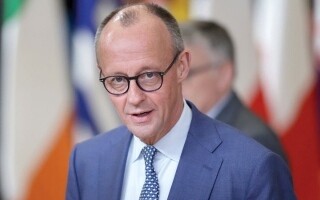
Despite disagreements among European governments, they are mostly focused on details rather than principles. German officials acknowledge that adopting a stricter policy towards China could have negative consequences for the German economy, given the country's heavy reliance on exports. Furthermore, the crisis over rare earth elements has served as a painful reminder of Germany's vulnerability. Nevertheless, some observers believe that Germany and Europe are losing their global economic weight, especially amid U.S. tariffs and the legal disputes surrounding them. According to Arthur Tarnowsky, head of the Beijing office of the Heinrich Böll Foundation, linked to Germany's Green Party, the loss of the European market would inflict heavy losses on China. The relationship between Germany and China is complex, with economic interests intertwined with geopolitical considerations in a relationship of mutual influence. This delay is seen as a sign that Merz's approach may differ from his predecessors'. The Chinese market is no longer just booming for German exports; broad sectors of German industry now see China as a direct competitor and a threat to their vital interests. Consequently, many economic actors expect the chancellor to clearly voice these concerns to Chinese leadership. During his three-day visit, Merz will visit Beijing and Hangzhou, one of China's key advanced technology centers, implicitly acknowledging China's current status as a major global economic and technological power. Merz also pledged to prevent Chinese companies from participating in the development of 6G networks in Germany. Within the European Union, Germany supports the 'buy European' requirement in support and procurement programs, though less stringently than France. However, some fear that excessive strictness could exclude partners like South Korea and Canada, who could help reduce carbon emissions. Amid this delicate balance, broad segments of German industry hope Chancellor Friedrich Merz will demonstrate firmness during his Beijing visit, reflecting a clearer defense of Germany's economic and strategic interests. Instead, he will prioritize a 'de-risking' policy due to Germany's heavy dependence on China. This approach is evident in efforts to address supply chain vulnerabilities exposed by German reliance, especially after China threatened to restrict exports of rare earth elements and chips, threatening to halt production lines and causing significant concern among German importers. Additionally, the trade imbalance is a key issue. From Germany's perspective, trade relations are no longer balanced. Exports of cars and German goods to China have fallen sharply, while imports from Chinese companies facing pricing pressures in their domestic market have surged, widening the trade deficit to around 90 billion euros, or about 2% of Germany's GDP. Weak domestic demand in China has pushed Chinese companies to increase exports, including cars, allowing them to capture market share from German competitors in other international markets. German industrial sectors express frustration over Chinese state subsidies and the devalued yuan, arguing that competition is no longer purely commercial but is backed by China's state capabilities. Oliver Richtberg, from the engineering industry association representing some 3,600 German and European companies, put it this way: 'German companies are not just competing with Chinese companies; they are competing with the budget of an entire state.' The Federation of German Industries confirms that competitive pressures span multiple sectors, from automotive to chemical and pharmaceutical, leading to what some Germans call the 'China shock,' referring to the radical shift faced by medium-sized family firms that had long operated in stable industries before being forced to rethink their business models. In the industrial powerhouse of Baden-Württemberg, some politicians warn of the risk of it becoming 'Europe's Detroit,' a metaphor reflecting anxiety about the future of the auto industry. However, not all German companies are united. Large conglomerates like chemical giant BASF have increased their investments in China. Other German firms are also looking to re-anchor their operations in China, leveraging local supply chains, developing products with Chinese talent, and reinvesting profits there. Yet, the visit's atmosphere will be colored by Germany's grim domestic political climate. The government believes Russian President Vladimir Putin cannot sustain the war in Ukraine without Chinese support, while German intelligence reports of suspected Chinese-linked cyberattacks and espionage are on the rise. Merz is expected to raise these issues with the Chinese president, though without expecting a major shift in positions. As Germany's export-dependent ties with China weaken, Beijing is demanding the EU lift tariffs on its electric cars. Sander Tordoir of the European Centre for Reform notes that Germany's China policy still lacks strategic clarity. Despite the visit's significance, Thorsten Benner of the Global Public Policy Institute argues that Germany's China policy is anchored in the European framework. Berlin has begun supporting stricter investment screening, as seen when Chinese company MingYang was blocked from a wind energy project in favor of Siemens Gamesa due to security objections.