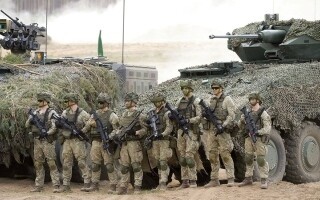
Almost all remaining contracts will stay in Europe, with most going to the German defense industry. For Europe, this means the European Union's economic engine is also becoming a defense industrial engine, as Berlin directs hundreds of billions into local production lines, while France and Southern states suffer from financial constraints. This shift is felt in Paris, where Germany's rearmament is viewed with a mix of suspicion and concern. This question is swirling in Brussels, where officials question how 'European' Germany's military buildup is. National interests Berlin continues to fiercely protect its national defense interests, resisting giving the European Commission greater authority in arms procurement and planning to rely heavily on national frameworks, including a new procurement law that will systematically use Article 346 of the Treaty on European Union. In France, there is a race to maintain its status, while in Poland, Germany's rearmament is reviving ghosts of the past and creating a sense that a Berlin-Warsaw alliance might be the most effective way to keep Russia at bay. In turn, SPD parliamentarian and member of the defense committee, Christoph Schmidt, said: 'Wherever I go in the world, from the Baltic states to Asia, people ask Germany to take on more responsibility'. For decades, the EU operated on the basis of an unspoken understanding that Germany would handle the finances and France the military, and now the tables have turned. As Germany seeks to become the dominant military power in Europe, the political balance is shifting. Poland, in turn, is struggling to keep public spending in check, a problem exacerbated by the sharp increase in defense spending. One EU official described the shift in Germany's military power as a 'radical shift' or a 'massive shift'. The continent's economic power is now turning into a defense-industrial power, while France holds onto its nuclear card and Poland becomes a heavy conventional force on NATO's eastern flank. In Brussels, this change is a test: can the EU channel this momentum toward shared structures, or will it lead to deepening defense divisions in the bloc? For now, Berlin's strengthening of its power is seen as a return to responsibility rather than an attempt at domination, but even supporters acknowledge the scale of the change is hard to grasp. One EU diplomat said: 'It might be scary, no doubt, but Germany has alliances, it is a member of the EU and NATO, and a lot can happen in that time'. Christoph Schmidt: 'All European countries are rearming'. From Politico. Shift of center of gravity in Europe towards the East Overall, Germany's rapid rearmament and the mixed reactions from its partners highlight how the center of gravity in Europe is shifting eastward. Today, Poland has the largest army in Europe and will be a very strong player in the future, so the plans for modernizing the German army must be seen in the right context. This article allows member states to bypass EU competition rules in favor of local contracts. Internal procurement documents seen by Politico show Berlin is set to push through €83 billion in defense contracts via parliamentary committees by the end of 2026. He added: 'The expectation is that Germany will finally step up and match its economic weight with its defense weight'. Germany, which has the largest army in Europe and is equipped with advanced tanks, missiles, and aircraft, is a far cry from the chaotic German army that was once mocked for its low morale and outdated equipment. This unprecedented rise covers all areas of the armed forces, from tanks and frigates to drones, satellites, and radar systems. This is just the opening phase, with a much longer 'shopping list' of €377 billion for the German military, a long-term plan covering more than 320 new weapons programs across all military domains. The most surprising part is the destination of these billions. In Warsaw, this step is seen as necessary and overdue. Former Polish ambassador to the US Marek Magierowski said: 'Poland has become a beacon among NATO allies in terms of defense spending. This military power is tied to political and economic weight, and Europe will have to adapt to a 'dominant Germany'. Major shift By 2029, Germany is expected to spend €153 billion a year on defense, which is around 3.5% of GDP, the most ambitious military expansion for the country since reunification. Thus, the insistence has been for other partners to follow suit. Magierowski added: 'But if we really care about collective defense, we cannot keep saying (please spend all more on defense, but not you, Germany)'. Polish officials, speaking to Politico, take the same pragmatic view. One of them said: 'They are moving in the right direction. From our point of view, it could have been done earlier, but it's good that it's happening now'. But the often bloody past casts a long shadow. Polish Deputy Defense Minister Paweł Zalewski said: 'If we look at history, we see that any situation where Germany tied its economic power to its military power has always been worrying. According to procurement plans, less than 10% of new contracts will go to US suppliers, a reflection of the long-standing situation where Berlin was one of Washington's biggest customers in the defense sector. One EU official said: 'In France, the defense apparatus is core to the system. While Paris suffers from debt over 110% of GDP and a deficit over 5%, Berlin's ability to borrow is the envy of its neighbors. Another diplomat put it more bluntly: 'It's the most important thing happening at the EU level right now'. For European diplomats, this rise raises more than just budgetary questions. However, not everyone sees Germany's rearmament as a threat. It challenges the story the group has long told itself about who keeps it safe. The expectation is that Germany will finally step up and match its economic weight with its defense weight. By 2029, Germany is expected to spend €153 billion a year on defense. The difference between Paris and Berlin is that any official in France is ultimately a defense official. Despite French President Emmanuel Macron's efforts since 2017 to improve Franco-German relations, distrust of Berlin remains deeply entrenched in French defense circles. By comparison, France plans to reach around €80 billion by 2030. Poland is seeking to spend €44 billion on defense this year, which is 4.7% of GDP, the highest in NATO, and plans to have one of the largest and best-equipped armies in Europe. The financial reality is also changing.