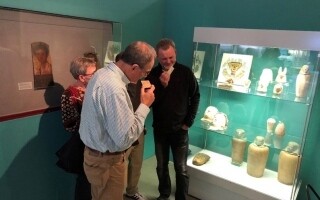
This is a modern technology that allows for understanding the aromatic, medicinal, and ritualistic practices adopted by the ancient Egyptians in their daily lives and religious customs. Teams of archaeological chemists, archaeologists, aromatic heritage consultants, and perfumery experts have created complex formulations from 20 ingredients to recreate these scents, while considering public safety and maintaining the highest fidelity to the original components. At the August Kestner Museum in Hanover, Germany, visitors can now explore scent cards carrying the aromas of ancient mummification. Meanwhile, the Moesgaard Museum in Aarhus, Denmark, has set up scent stations that offer a rich sensory experience and help visitors understand the motivations and rituals of the ancient Egyptians beyond stereotypical ideas of horror and death. Researchers also clarified that these scents do not just add a new dimension to the museum experience; they give the visitor an emotional and sensory link to the historical environment and practices that were part of the ancients' lives. Barbara Huber, an archaeological chemist involved in the study, stated: 'Molecular data gives us essential evidence, but the perfumer's task is to transform it into a complete olfactory experience that mimics the original complexity of the ancient materials, not just their individual components.' The team hopes that these innovations will contribute to transforming museums into more interactive places where visitors can explore history through their senses, not just their eyes or by reading. A team of scientists has succeeded in recreating perfumes that were used in mummification rituals by the ancient Egyptians more than 3,500 years ago, a revolutionary step that could pave the way for multi-sensory museum experiences in the future, according to the 'Independent' newspaper. Researchers from the Max Planck Institute in Germany relied on analyzing the volatile organic compounds that remained in the canopic jars of the noblewoman Senetnay, who lived around 1450 BC.