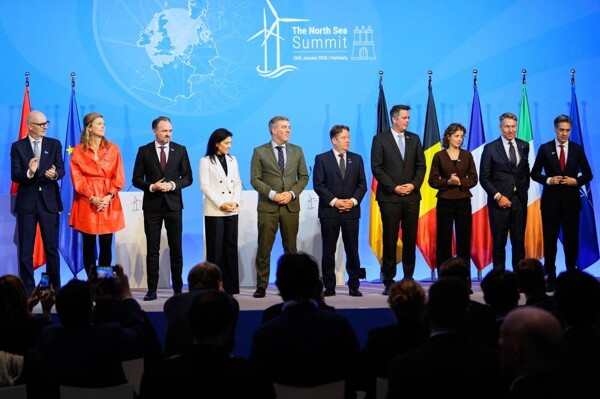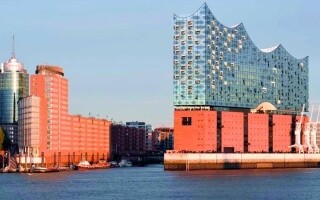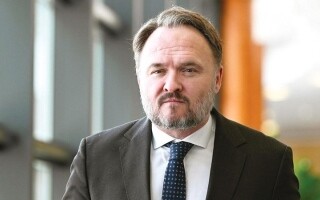
A group of Northern European countries committed on Monday to building climate-friendly wind energy in the North Sea to achieve greater energy independence and reduce reliance on foreign suppliers. The German Chancellor, Friedrich Merz, hosted a summit in the port city of Hamburg last week, as Europe faces not only security challenges but also concerns about the future of transatlantic relations and U.S. plans for Greenland. To make Europe more resilient in an unstable world, the group of nations pledged to boost offshore wind energy in the North Sea, turning it into «the world's largest clean energy reservoir». These countries agreed to generate an additional 100 gigawatts of power from wind turbines, enough to supply about 100 million homes through «massive joint projects for offshore wind energy». Germany and Denmark also agreed on a project called the «Bornholm Energy Island,» which will see an additional 3 gigawatts of offshore wind power connected to both countries. Merz said, «The North Sea is a harsh environment, but it offers huge opportunities.» Last week, Trump backed down from his threat to use force to seize Greenland, a self-governing Danish territory, and did not impose punitive tariffs on European NATO allies who stood in his way. Among the leaders in Hamburg was Danish Prime Minister Mette Frederiksen, who visited Greenland last week. She is also on high alert for sabotage and suspected surveillance, including the cutting of seabed cables and mysterious drone flights over airports and critical infrastructure. Imported liquefied natural gas from the U.S. helped replace Russian gas in supporting Europe's energy sector. This European wind energy push came days after U.S. President Donald Trump, a staunch oil supporter who denies human-caused climate change, called wind farms «losers.» In turn, British Energy Secretary Ed Miliband said, «Offshore wind is for the winners and is absolutely vital for our energy security.» He added, «By investing in the North Sea as Europe's energy hub, we can boost Europe's energy resilience,» noting that it will also provide affordable energy for consumers, support the offshore energy industry, and help Europe achieve climate neutrality. EU Energy Commissioner Dan Jørgensen, after the agreement was signed by other countries including Belgium, the UK, France, and Norway, confirmed that the agreement is «a very clear signal to Russia.» He added that it provides «local and clean energy that we control and is not subject to foreign control.» Proponents of wind energy point out that it is beneficial not only for the climate but also for security, as these decentralized systems are more resistant to sabotage and attacks than traditional power plants, pipelines, or oil tankers. Simon Skillings from the E3G research center said, «The recent hybrid attacks on infrastructure and the war in Ukraine have shown that the most distributed infrastructure is the most resilient,» adding, «Multiple attacks could disrupt these energy supplies.» The Hamburg talks came as the issue of Greenland and Arctic security in general has come to the forefront. «We want to strengthen our own energy, our future strategy is to break free from gas.» Germany and other EU countries are striving to end their dependence on Russian energy imports since the outbreak of the Russia-Ukraine war in 2022. Jørgensen at a press conference said, «We will not allow you to blackmail EU member states anymore, and we will not indirectly finance the war in Ukraine anymore.» Jørgensen also touched on whether the EU wants to reduce its dependence on U.S. gas imports in the future. «We need to build a much stronger Europe.» Frederiksen added, «To achieve that, we need to become more self-sufficient, competitive, and independent.» She said, «Relying on Russian fossil fuels in the past was a grave mistake,» adding, «Now we must ensure that we do not depend on other countries outside Europe, not only in energy, but in everything.» Source: The Japan Times She said, «Europe has shown its strength and unity in recent weeks,» continuing, «I am grateful, but I must also say that this is the only way forward.» She said, «We want to deal with the U.S. on as many issues as possible.» But she added, «We are not aiming to replace one dependency with another.»