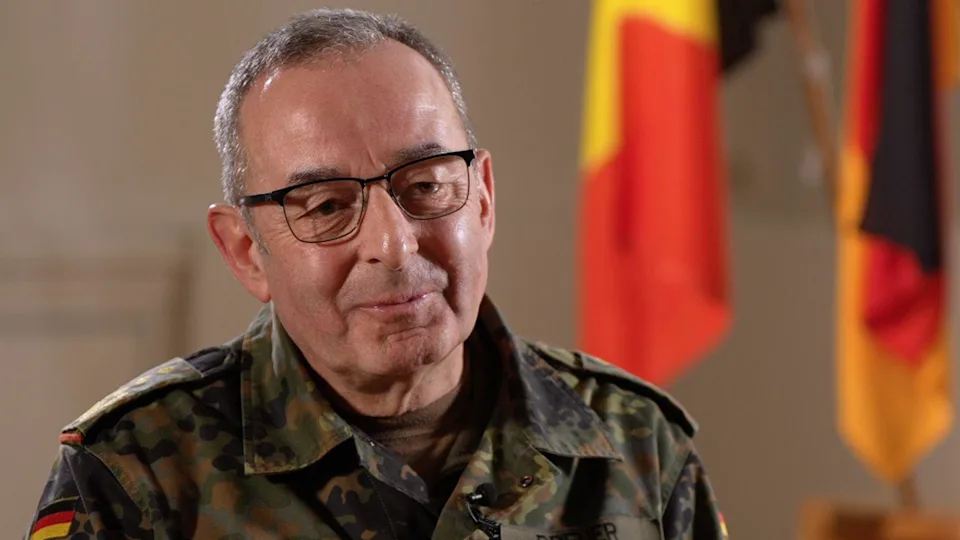
For Germany, the problem is not just to spend more, but to rebuild real military capacity after decades when hard power had been politically sidelined. It is cultural. Germany is starting to accept that in the Europe of 2026, historical moderation is no longer enough on its own to guarantee peace. The memory of German militarism still weighs heavily, but today the dominant fear in much of the continent is no longer a Berlin that is too strong, but a Europe that is too weak against an aggressive Russia that has turned war back into a tool of foreign policy. German military strength today is between 183,000 and 184,000 soldiers, far from the needs that the government itself and NATO are beginning to project. The country that for decades cultivated a near-structural military restraint, marked by the weight of the Nazi past and a political culture averse to the display of force, has started to push that limit and assume that the European map has already changed. Under that logic, it ordered that German forces be fully equipped for that horizon and set priorities that show where it sees the greatest weaknesses today: anti-aircraft defense, drone interception capability, munitions, long-range precision strikes, and the accelerated rebuilding of material reserves. It is a leap in scale that transforms not only the military budget, but also Germany's role on the continent. However, the rearmament does not start from a comfortable position. The signal is unequivocal: Germany has stopped thinking of its armed forces as a secondary tool and has begun to treat them as a central piece of European security. This turn also has political leadership. The official goal is ambitious: to move towards 260,000 active personnel and 200,000 reservists by the middle of the next decade. Therefore, the real German change is not just budgetary or military. The war launched by Russia against Ukraine, the growing pressure on NATO, and the perception that Moscow could rebuild enough offensive capability to challenge the alliance before the end of the decade have pushed Berlin to break a taboo that seemed untouchable. The face of this new stage is General Carsten Breuer, head of the Bundeswehr, who has been warning for months that Russia could be in a position to attack NATO territory by 2029. The data shows that German society is still debating the pace and form of rearmament, but it no longer rejects it with the automatic reflex of other eras. What is happening, in the end, goes beyond the defense policy of a single country. Germany is beginning to assume that the protection of the continent can no longer rest almost exclusively on the United States, especially when Washington is multiplying demands for Europe to carry a much larger share of its own security. The novelty is that an improvement in recruitment has already been noticed: the Ministry of Defense reported in July 2025 a 28% increase in new recruits compared to the same period of the previous year. The government pushed a historic reform of the constitutional debt brake to exclude spending on security above 1% of GDP from the fiscal limit, and at the same time agreed on an extra-budgetary fund of 500 billion euros for infrastructure. A Reuters investigation published this year described that the preparedness of the German army was even lower than when Russia invaded Ukraine in 2022, with marked deficits in air defense, artillery, troops, and the actual availability of units. In this new context, the largest country in the European Union is being pushed to occupy a place that it avoided for decades for historical, moral, and political reasons. Chancellor Friedrich Merz promised to rebuild the Bundeswehr as 'the strongest conventional army in Europe,' a definition that would have been unthinkable in German political language not too long ago. The Russian threat, read in Berlin as a real threat and not as an academic hypothesis, ended up serving as the great accelerator of a mutation that redefines the European power architecture. The great paradox is that this turn occurs precisely because European history did not stay in the past. That is why, as of January 1, 2026, a new military service system came into effect that maintains the principle of voluntariness but obliges men born since 2008 to register, fill out questionnaires, and undergo medical evaluations. That detail explains why the German debate is no longer just about buying weapons, but about rebuilding structure, doctrine, reserves, and personnel. And there another decisive dimension appears: personnel. With this new framework, the total projected defense spending for Germany would rise from 95 billion euros in 2025 to 162 billion in 2029, with the goal of taking it to 3.5% of GDP. Berlin, April 1, 2026 - Total News Agency - TNA - Germany is protagonizing one of the deepest strategic turns in its post-war history. Behind that phrase there is not just rhetoric. The Bundeswehr still carries severe shortcomings inherited from years of underinvestment and the post-Cold War strategic comfort.