Friedrich Merz, who formed a coalition including the Christian Democratic Union, the Christian Social Union, and the Social Democratic Party, served as Chancellor of Germany for only eight months. From the very beginning, his tenure was fraught with troubles, as he secured a razor-thin parliamentary majority. Immediately after the elections, he shed the burden of his uncomfortable election program with the help of the Green Party, approving a massive debt program worth half a trillion euros. When his election as chancellor failed in the first parliamentary vote, he even accepted support from the Left Party, along with the Greens, to rectify this embarrassing situation.
None of this deterred Merz. He set ambitious goals, with the aim of new foreign, defense, and economic policies to restore a weakened Germany, and thus Merz himself, to a position of power in Europe.
However, it is now clear that the German chancellor and his government lack any long-term strategy. Despite all the big promises he made at press conferences, Merz never managed to overcome the inherent flaws and weaknesses of his administration. As a result, his policies are exclusively geared towards short-term and daily survival. What's more, to add insult to injury, the implementation of these misguided goals was marked by improvisation.
Two Political Failures
There are two clear political failures that demonstrate that Merz's foreign and economic policies cannot succeed. The first is the planned seizure of 210 billion euros in Russian assets held in Belgium. The second is the loudly announced, but purely political, 'autumn of reforms,' which was supposed to get the German economy back on track.
The idea of seizing 210 billion euros from the assets of the Russian central bank, mostly frozen in the Belgium-based financial services company Euroclear, and converting them into a forced loan to fund Ukraine's war efforts, was one of the central goals of Merz's government's foreign policy last autumn. But why was the German Chancellor so keen on this plan? The answer is clear... After the United States withdrew from funding Ukraine, it is expected that Europeans will bear the financial burden. The German federal government is, according to reports, bankrupt, while the economic situation remains difficult. To at least show some semblance of action, something had to be done for Ukraine. In the search for money, attention inevitably turned to those assets.
An Unwise Idea
However, the idea of seizure itself is politically unwise. These assets are in Belgium because the European Union enjoys an international reputation as a relatively safe jurisdiction for capital. If this reputation is damaged, the euro's status as a global reserve currency will be at risk, giving other countries, especially China, a strong incentive to develop alternative financial centers.
Furthermore, even in times of war, it is reasonable to say that some channels of communication with Russia should remain open, at least to maintain a minimum level of contact. Respecting Russian property rights was an opportunity to achieve this. Ironically, it was the administration of U.S. President Donald Trump that pointed this out, while the German government, which is usually keen on upholding the rule of law, ignored it.
If Belgium had taken on the unreasonably large and risky responsibility of such a scale, it would have created a dangerous precedent that would have concerned smaller EU member states. But Merz's short-term activities pushed these strategic considerations completely into the background. Fortunately, the implementation of these plans was so unprofessional that Belgium and French President Emmanuel Macron were able to overcome Merz.
Sharing the Blame
The German Chancellor and his European Affairs Minister, Johann Wadephul, arrived at the EU summit in mid-December last year, publicly demanding a forced loan to help Ukraine. Their promise was that Russia would cover the costs one day in the unspecified future through reparations, and thus would effectively pay for the seizure of its own assets.
Belgium responded to this flimsy argument by saying: 'If the seizure is really risk-free, why not share the responsibility among all 27 member states?' At that moment, the German government, which had arrived at the EU summit without an alternative plan, was already in a bind.
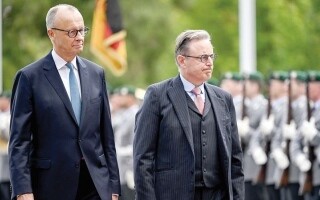
Belgian Prime Minister Bart De Wever showed a sharper political sense than the German leader. He realized that France and Italy would never agree to shared responsibility. It was Macron's moment: why not issue European joint bonds? Suddenly, the dream that every French government has long held—a tool for joint European borrowing—seemed much more coherent than Merz's plan.
French negotiators managed to impose this mini-euro bond issue on the German Chancellor. By the end of the summit, Merz was once again caught up in a new wave of massive debt, a wave that German taxpayers will largely have to bear.
From "The American Conservative"
Election Year
2026 will be a significant election year for Germany, with around 36 million German citizens (about 60% of eligible voters) voting in multiple elections at the state and local levels. The five state elections are of particular importance, as they will not only determine the prestigious posts of state premiers but also the composition of the upper house of the federal legislature. These elections will be a referendum on the federal government and Chancellor Friedrich Merz himself.
Poll numbers for the Christian Democratic Union and the Social Democratic Party in Germany are weak across the board. In the east of the country, the question is whether the Alternative for Germany party will win an absolute majority.
It is known that the CDU plans to rely on the Greens or even the left-wing party 'Die Linke' to form a majority in many states. This would push the German party system towards a de facto two-bloc structure, where members of the CDU, CSU, SPD, Greens, and Die Linke would unite against the Alternative for Germany.
However, under these circumstances, the CDU and CSU can only lose. Thus, instead of reviving Europe's grandeur under Merz's leadership, it seems more likely that his own party will decline. The 'autumn of reforms,' loudly announced by Merz, was merely political rhetoric and did not get the German economy back on track. The idea of seizing Russian money is unwise because even in times of war, some channels of communication should remain open.