Since reunification in 1990, Berlin has gained a prominent position in international relations, focusing on soft power and non-coercive influence, and prioritizing cooperation, diplomacy, and economic interconnectedness as functional alternatives to hard power. In this context, Germany saw itself as a 'civilian power' and a 'moderate power investing through diplomacy, development, and defense' in regional and global institutions to provide public goods. This reflects its leadership in climate diplomacy and its status as one of the world's largest providers of official development assistance.
These liberal institutional tools of foreign policy were suitable for the first decades of the post-Cold War era and helped to boost Germany's status as one of the world's leading economic and political powers. However, this success also reinforced an existing image based on values that Berlin saw as 'benign and superior', often presented with a heavy dose of moralizing. Although the concept of 'civilian power' remains valid, public goods still depend on providers and advocates who act collectively and concertedly, but it comes amid a resurgent competition among great powers. For Germany's civilian power to maintain its influence, its institutional core must be complemented by more stringent and realistic components. In other words, hard power offers an opportunity to effectively showcase soft power in the current geopolitical landscape.
Since reunification in 1990, Berlin has gained a prominent position in international relations, focusing on soft power and non-coercive influence. Germany's defense policy is a pivotal and decisive factor in its foreign policy, with the potential to reactivate German hard power, not only within European and Atlantic frameworks but also on a global scale. Germany needs to rethink the balance of its hard and soft power if it wants to enhance its global role amid the rapidly deteriorating conditions for exerting its soft power. Other middle powers, such as Britain and France, learned this lesson long ago. However, for Germany's political elites and civil society, this entails a profound renegotiation of the values and interests underpinning its foreign policy.
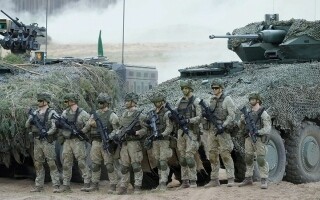
In this context, the war in Ukraine has effectively opened the door to a genuine turning point in German defense policy, which former Chancellor Olaf Scholz dubbed the 'Zeitenwende' in 2022. In the face of illiberal alliances and authoritarian blocs, Germany's defense investments should also be seen as a contribution to burden-sharing within NATO, enabling other allies to focus more on the Indo-Pacific region. These efforts also serve as an alliance signal, showing solidarity with regional NATO partners, and are bolstered by a more visible, if not more aggressive, presence of the German armed forces.
Examples of this include the German frade Baden-Württemberg's transit through the Taiwan Strait in 2024, and the participation of German air transport and paratrooper units in 2025 in 'Talisman Sword' exercises alongside Australia, the United States, and 16 other countries. The German navy will continue to deploy its ships in the Indo-Pacific region, although the presence does not imply permanence. Alongside close cooperation with Poland, the Baltic states, and Scandinavia, the priority for the German armed forces remains reinforcing the alliance's eastern flank.
Despite its shortcomings, Germany's defense policy is a pivotal and decisive factor in its foreign policy, with the potential to reactivate German hard power not only within European and Atlantic frameworks but also on a global scale, which could expand the scope of Germany's traditional soft power. However, this realistic rethink must take a genuinely global perspective, requiring Germany to redefine its alliances and complement its traditional partnerships based on shared values within the G7 and other democratic frameworks with more realistic relations with like-minded countries in other regions, particularly the Indo-Pacific, where many international stakeholders are concentrated. Although Germany cannot offer cooperation frameworks akin to the AUKUS agreement, under which the U.S. transfers submarine nuclear technology to Australia, this new approach necessitates a re-evaluation of foreign policy tools and a more realistic approach, involving redesigning development, science, and technology policies, and arms exports to offer more attractive cooperation in partners' priority areas.
Many of these lessons are, and have already begun to be, integrated into the broader strategic reassessment of NATO and the European Union.
Source: 'The Strategist'.